Window Patching Machine Selection: 7 Details to Confirm
November 3, 2026
Peel-and-Seal Envelope Machine: Which Line Do You Need?
November 10, 2026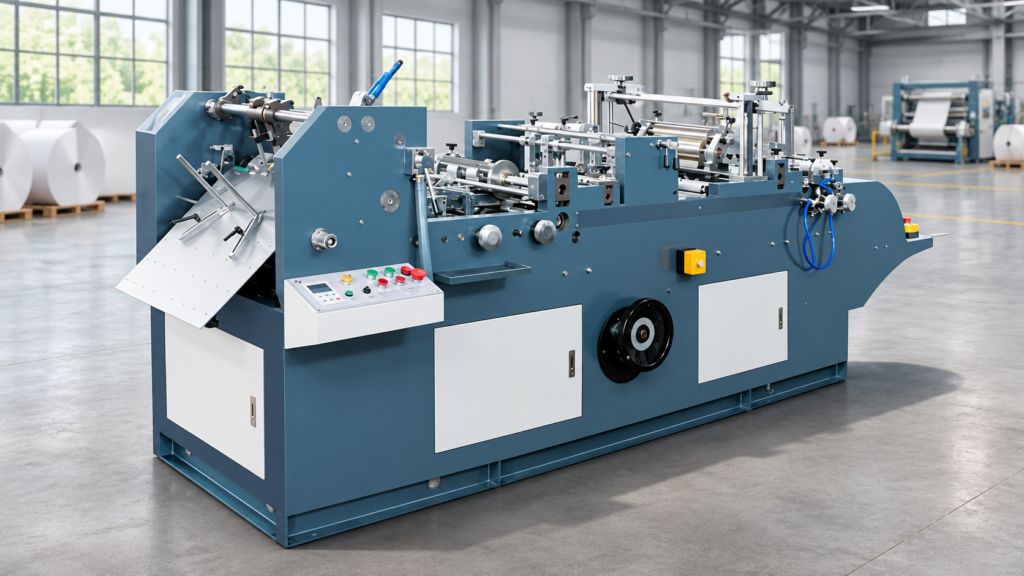
Wallet and pocket envelopes may look similar in a catalogue, but the finished format, flap direction and closure determine what your machine must do. Before comparing headline speed, define the envelope you actually need to ship. A finished sample and a flat blank are more useful than a model name alone.
The short version
Start with four decisions: wallet or pocket format, finished dimensions, paper weight, and closure method. Then ask the supplier to confirm the exact model variant and demonstrate the result with your own material. Published output ranges are reference figures, not a guarantee for every envelope.
Wallet or pocket: what should you specify?
In common envelope terminology, a wallet envelope has its opening flap on the long edge; a pocket envelope opens on the short edge. That distinction changes the blank orientation and the production setup. For a machine inquiry, do not rely on the label alone: send a photo or physical sample showing the front, back and open flap. Include a dimensioned drawing if the format is new or customized.
- Finished format: record width and height, flap style and opening side.
- Blank: provide the flat die-cut shape and crease positions.
- Paper: identify grade, basis weight, coating and any print or surface treatment.
- Closure: state whether the envelope needs standard glue, self-seal or peel-and-seal tape.
This is also the point to specify whether window film, special inserts or another finishing process is required. A machine that forms the envelope is not automatically configured for every optional finishing operation.
How the closure changes the machine choice
A conventional glued envelope and a peel-and-seal envelope do not have the same process requirements. Peel-and-seal adds tape application and a release liner to the production flow, so tape width, placement and adhesion need to be reviewed alongside folding and gluing. Ask the supplier to identify which modules are included in the quoted configuration, and test the closure on the intended stock.
HAOXING lists the ZF-380/A/C wallet and pocket envelope making machine for folding, gluing, counting and delivery. For a peel-and-seal format, its ZF-480/A peel-and-seal wallet and pocket envelope making machine includes inline tape application in the published product description. These are model families, not interchangeable specifications: confirm the particular variant, tooling and options on the final quotation.
Do not compare model families by maximum speed alone
The ZF-380 product page lists different size limits and output ranges for ZF-380A, ZF-380 and ZF-380C. It also notes that actual production depends on the paper and envelope format. The ZF-480/A page separately describes peel-and-seal configurations. A higher published capacity on one model does not prove it will run your format faster or with less waste.
For a fair comparison, give each supplier the same sample, paper specification and target quality standard. Ask for the conditions behind any quoted rate: envelope size, material, adhesive or tape, and acceptable finished-piece criteria. Record changeover requirements if you plan to run several formats on one line.
What to check in a sample trial
- Feed the actual paper or printed blanks you intend to use.
- Check separation, registration and crease alignment.
- Inspect fold symmetry and finished dimensions across a run.
- Check glue placement or tape position and liner handling, as applicable.
- Count good pieces, rejects and stoppages under agreed test conditions.
- Keep approved samples as the reference for future production.
A short, documented trial is more informative than comparing brochure figures without the operating conditions. The purpose is to verify a configuration for your job, not to assume that every optional function is standard.
What to send HAOXING for a useful recommendation
Send a finished envelope and flat blank, dimensions in millimetres, paper type and weight, closure type, expected order sizes, and target output. If several formats will share the line, provide the smallest and largest examples. You can then review the envelope making machine range and contact HAOXING to confirm a suitable model, tooling and sample-trial plan.